01
Hierarchical Dual-Level Routing
Separates local representation refinement (Inner MoR depth loops) from global token exiting (Outer MoR stage gates) for orthogonal optimization of depth and stage budget.
Built on the open research stack the field runs on
SoLS AI is a research lab building the next generation of foundation models that think adaptively — allocating computation dynamically based on the difficulty of each token, instead of wasting fixed compute on every input.
Our flagship architecture, RecurrMoE, unifies temporal compute allocation (recursion) and spatial parameter routing (experts) into one hierarchical system — achieving what static transformers can't: intelligent, token-level compute budgeting.

One architecture that addresses the fundamental bottlenecks of adaptive computation.
Separates local representation refinement (Inner MoR depth loops) from global token exiting (Outer MoR stage gates) for orthogonal optimization of depth and stage budget.
A Top-2 SwiGLU expert network inside the recursive block routes tokens through time and space — yielding 36 virtual expert paths from just 4 physical experts.
Resolves the recurrent KV-cache write-overwrite bottleneck with a unified virtual index V = p · d_max + d, maintaining strict training-inference parity.
Prevents out-of-distribution logit corruption by applying dynamic validity masks that isolate early-exited tokens from deep attention gathers.
Scales the effective context window from 2,048 to 8,192 tokens via a three-phase curriculum with NTK-by-parts rotary interpolation.
Eliminates the quadratic O((T·D)²) overhead of 2D parallel masking, restoring standard O(T²) attention through autoregressive virtual-layer mapping.
From research notebooks to production inference, RecurrMoE spends thinking time only where the work is hard.


Serve more requests per GPU with token-level early exit and MGQA cache savings.

Open methodology, published benchmarks, and a fully documented training curriculum.
A three-level nested adaptive computation framework: Outer MoR for stage routing, Inner MoR for recursive refinement, and MoR-based MoE for expert specialization.
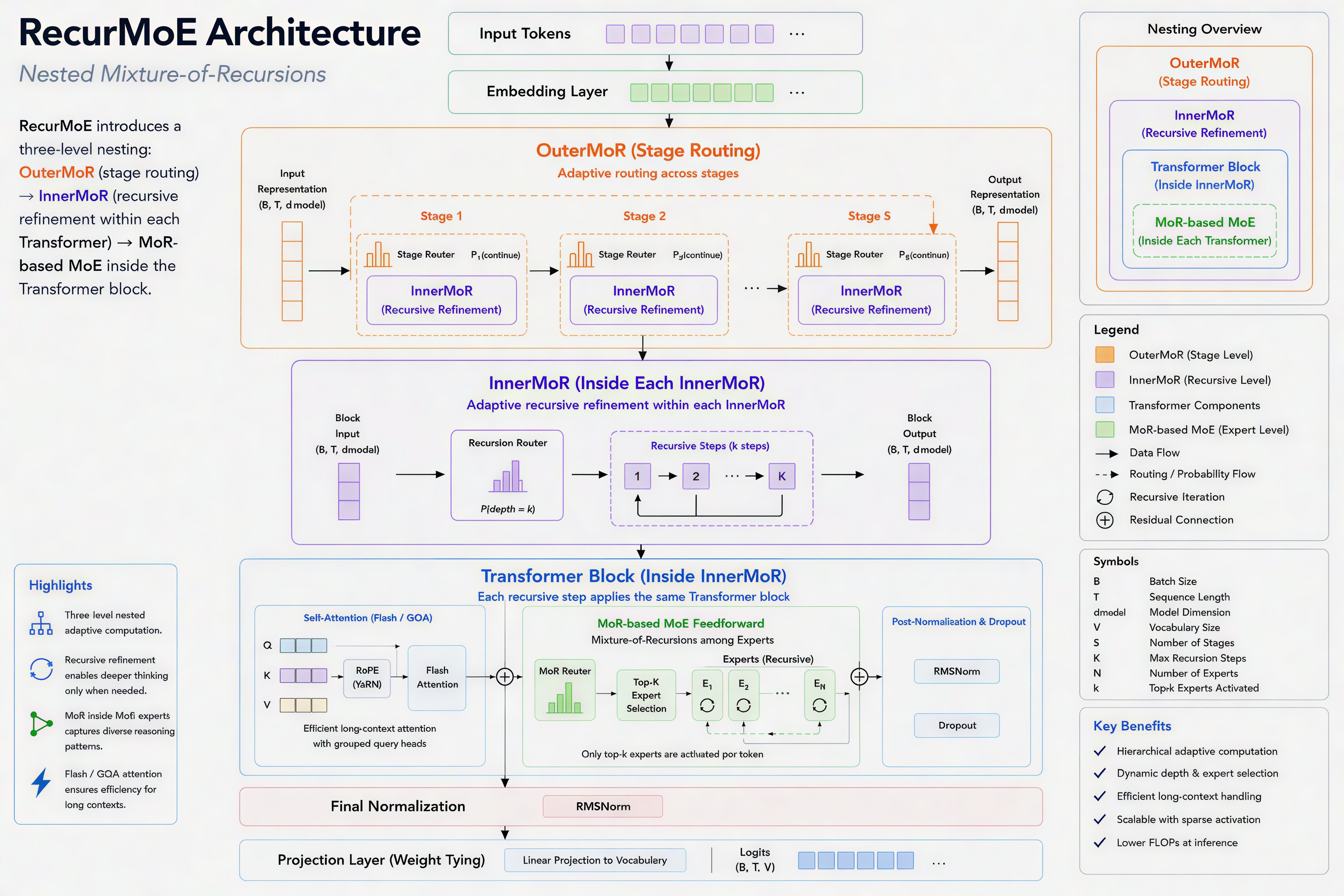
Three nested levels — Outer MoR (stage-level early-exit routing), Inner MoR (adaptive recursive refinement), and MoR-based MoE (sparse top-k expert selection per transformer block).
RecurrMoE-1B delivers genuine compute reduction in deployment while staying competitive on standard benchmarks.
| Benchmark | Accuracy |
|---|---|
| MMLU | 24.83% |
| ARC | 21.08% |
| HellaSwag | 25.90% |
| WinoGrande | 49.41% |
| TruthfulQA | 8.57% |
| Average | 25.96% |
Efficient foundation models unlock new economics for everyone shipping or studying AI.

Cut inference cost per request without sacrificing answer quality — make AI economics work at scale.

Open architecture, published curriculum, and clear benchmarks make RecurrMoE a foundation to build on.

Lower energy footprint and GPU spend for the same workloads — a credible path to greener AI operations.
"Adaptive depth is the right bet for efficient inference. RecurrMoE's virtual-layer mapping is an elegant solution to the recurrent KV-cache problem."
"A 44% compute reduction at parity quality changes the cost equation for anyone serving models. This is the kind of efficiency work the field needs."
"Clear methodology and honest benchmarks. Open research like this is exactly how green AI moves from slogan to practice."
A 1B-parameter architecture featuring hierarchical dual-level routing, embedded sparse MoE, virtual-layer KV mapping, and entropy-regularized exit masking. Pretrained on 12B tokens across a three-phase curriculum.

A multidisciplinary team of researchers and engineers pushing the boundaries of efficient AI.
From foundational research to production-ready adaptive AI systems.
Designed the hierarchical MoR architecture, pretrained on 12B tokens across a 3-phase curriculum using 2× NVIDIA A100 80GB GPUs.
✓ CompletedPublished the architecture paper on Zenodo (DOI 10.5281/zenodo.20570332) with full methodology and benchmark results.
✓ CompletedScaling to 7B parameters with extended pretraining on 100B+ tokens across multi-node GPU clusters with enhanced expert diversity.
● In progressA production-grade inference engine with optimized virtual-layer KV cache, expert parallelism, and a developer API for adaptive model serving.
◇ UpcomingOpen-source release of the RecurrMoE training framework, pretrained checkpoints, and evaluation tools.
◇ UpcomingRecurrMoE is a 1B-parameter foundation-model architecture that unifies adaptive recursion (deciding how long to think about each token) with sparse Mixture-of-Experts routing (deciding which parameters to use). It produces the same quality output as a static transformer while spending substantially less compute.
Tokens that are easy to predict exit the network early, while hard tokens recurse deeper. Combined with sparse top-2 expert selection and virtual-layer KV mapping, the model averages an effective depth of ~10 of 18 layers — roughly 44% less computation per token in deployment.
Yes. The full paper is published open-access on Zenodo with a permanent DOI, including the architecture, the three-phase training curriculum, and all benchmark numbers reported here.
The paper is open access today. An open-source training framework and pretrained checkpoints are planned for Phase 5 of our roadmap. Reach out if you'd like to collaborate sooner.
We're seeking compute sponsors, research collaborators, and partners aligned with efficient, sustainable AI. Email research@sols-ai.com and we'll get back to you.
We're seeking visionary partners — investors, compute sponsors, and research collaborators — who share our mission of making AI fundamentally more efficient.